

UPDATE: July 9, 2026 –– The Sun can confirm exclusively that Alpha School is also opening a second campus at 1909 Colorado Ave. They will be taking over the space occupied since 1990 by Santa Monica Montessori School.
A new Santa Monica private school with no credentialed teachers says it can deliver better results than Harvard-Westlake — by teaching kids with artificial intelligence for just two hours a day.
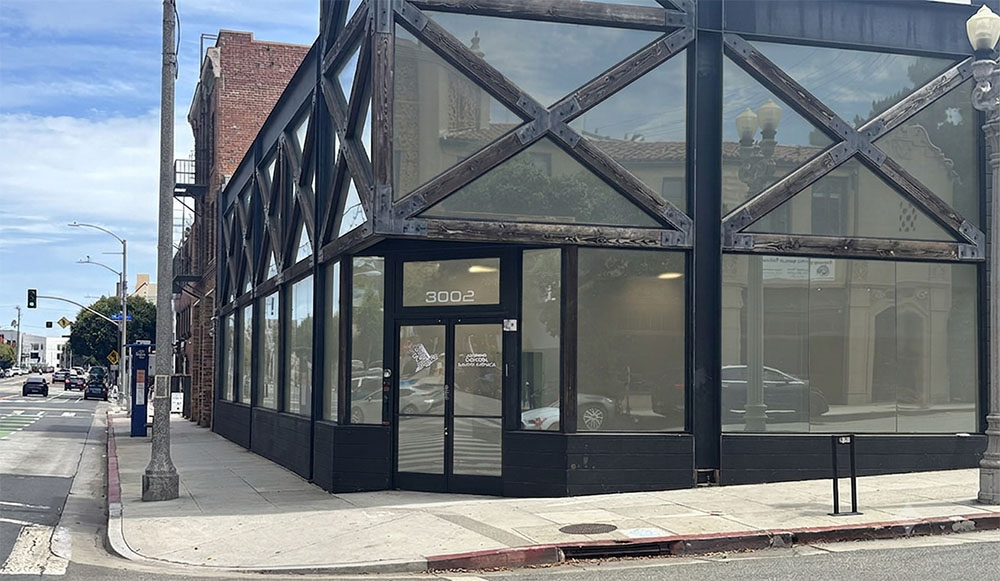
Alpha School Santa Monica, opening next month at 3002 Main Street, is closely linked to tech billionaire Joe Liemandt and comes with a $65,000 annual price tag. Its pitch: students can learn up to “10 times faster” using a proprietary AI-driven platform. That frees up the rest of the day for tackling hands-on life skills like entrepreneurship, public speaking and financial literacy.
“We’re outperforming top private schools like Harvard-Westlake,” company rep Anna Davalantes tells the Sun, pointing to internal comparisons of standardized test scores. “We’re indexing higher, even though they completely self-select for test scores and grades. [Alpha is] still way outperforming what Harvard-Westlake has on their SATs, their ACTs, their CAASPP scores… So in that apples-to-apples comparison, you can see there really isn’t a comparison.”

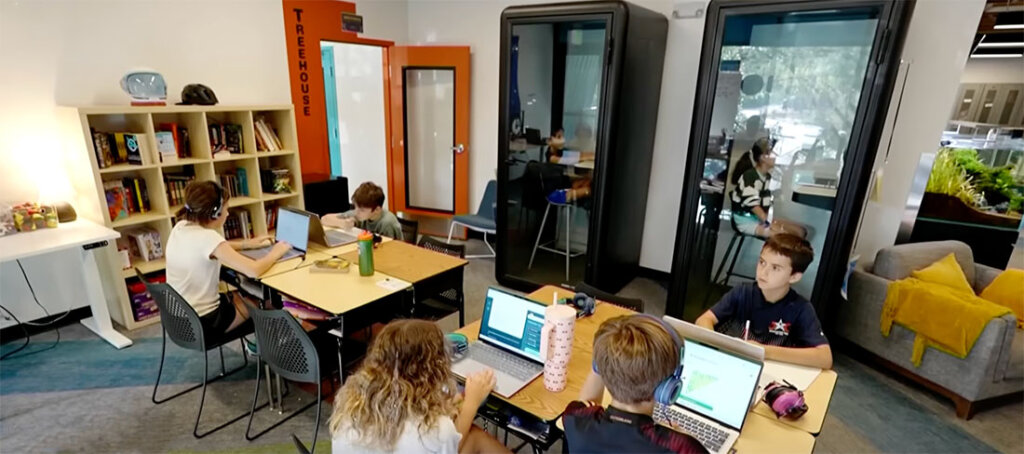
Alpha’s ‘teacher-less’ classroom
At Alpha School Santa Monica, traditional teachers are replaced by “guides” — many are former coaches or camp counselors — and they’re paid far more than our local SMMUSD teachers. The company is currently offering compensation of up to $150,000 a year to candidates who can “establish a culture where mediocrity isn’t an option.” Interest in the role has been intense, with roughly 90,000 applicants nationwide.
According to the company’s own recruiting materials, a guide’s success is measured by a strict formula: students must hit weekly academic goals, pass every “life skills” checkpoint, and 90% of students must “say they love you.” Miss any one of those targets, and “you’re missing the job.”
Algorithmic learning, outsourced support
“The learning comes through the device,” says Derek Bergmann, a guide at the Santa Monica campus. “But what really unlocks it is that guide next to the student, helping them stay in that ‘Goldilocks zone’ — not too hard, not too easy.”
Alpha says its guides spend a minimum of 30 minutes with each kid weekly, helping them set personal and academic goals. If a student gets stuck, guides are not permitted to help. Instead, the student can schedule a meeting with an “academic specialist,” Bergmann says. Several published reports indicate that the majority of these interventionists reside outside of the United States –– in places like the Philippines and Colombia.
Students spend two hours each morning on individualized academic work delivered through Alpha’s platform. After that, screens are put away, and the day shifts to real-world activities. On any given day, that might include restoring neighborhood planters, learning outdoor survival skills or even assembling furniture.
Silicon Valley vs. screen time anxiety
The Alpha model is gaining traction as many parents in our community are pushing back on the use of screens for learning. But, Bergmann argues, “technology is a tool — it comes down to the intention with which the tool is used.” The school also notes that phones are not allowed on campus, and screen use is tightly controlled.
Additionally, Alpha stresses that it does not use interactive chatbots like ChatGPT. Instead, it relies on a closed-loop system tailored to each student’s pace.
From Main Street to a billion students
Alpha School Santa Monica will begin with about 30 families — a deliberate strategy the company uses to seed new locations before scaling. That growth can happen quickly. In Miami, Alpha started with a similar group of students in 2024 and has now expanded to almost 150.
Alpha already operates learning communities in Santa Barbara and Lake Forest. The company will soon debut in Manhattan Beach, Beverly Hills, and Malibu. The Santa Monica site is expected to relocate to a larger space after its first year.
But for Liemandt and his team, the ambition is much larger than a few Southern California classrooms. Alpha’s stated corporate goal is to expand its system globally to reach more than a billion students.
To achieve that scale, the business model replaces traditional school infrastructure with automation. Because all academic instruction is delivered through software, the company explicitly eliminates the requirement for certified classroom teachers.
The system also applies tech-industry metrics to student motivation. According to the company, its playbook uses behavioral economics to drive daily app progress. Students earn a digital school currency called “Alpha Bucks” for hitting their speed and performance targets, turning daily learning into quantified metrics.
Ultimately, Alpha is betting that data can rival legacy academic prestige. By publicly claiming its software outpaces the test scores of schools like Harvard-Westlake, the company’s business strategy appears to be built on proving that a proprietary platform can deliver better measurable outcomes than traditional human interactions.
Alpha is not for everyone
Admission is selective, with prospective students required to complete a trial day and demonstrate what the company calls “Alpha readiness,” including independence, sociability and a willingness to be coached.
“Alpha doesn’t select at all for test scores,” Davalantes insists. “It self-selects for motivation.” She adds that students with ADHD, dyslexia and other learning differences are part of the program, with progress measured against personalized baselines.
Still, the model — high cost, heavy tech, and a redefinition of what a “teacher” is — is likely to draw strong opinions in a city where education choices are closely watched.
For now, the experiment is arriving on Main Street — where parents will soon decide whether two hours of AI-powered learning can really rival one of L.A.’s most elite institutions.
UPDATE 7/7/26: After publication, Davalantes reached out to The Sun and requested to make the following clarification about comments contained in this story:
“Alpha’s academic outcomes are aligned with Harvard Westlake and other top tier private schools, but the approach to learning is completely different. Alpha’s system adapts around each child’s individual needs to allow the curriculum to adjust to the student, not the other way around. In this way, students learn the way that’s best for them, develop long-term mastery and move at their own pace. They also have fewer learning gaps than most kids because they don’t move on until they truly understand a concept. Learning this way is also more efficient which gives Alpha students their time back to build life skills like financial literacy.”


- Week 9: Great nights for Samohi, Saint Monica, Palisades - October 17, 2026
- The Farms: losing $30K per month after secret sub-lease tax dispute, closing October 30 - October 16, 2026
- Cheat Sheet 10/16: Santa Monica news, entertainment, sports, events - October 16, 2026
